How Much Storage Modern Games Actually Need
Published install sizes for current PC games, why the SSD stopped being optional, and what console storage really leaves you. Every figure quoted from the publisher's own listing.
A 1TB drive sounded generous a few years ago. Five current games can fill more than half of it. Here is what publishers are actually asking for, taken from their own store listings on 22 August 2026, and what that means for how much space to buy.
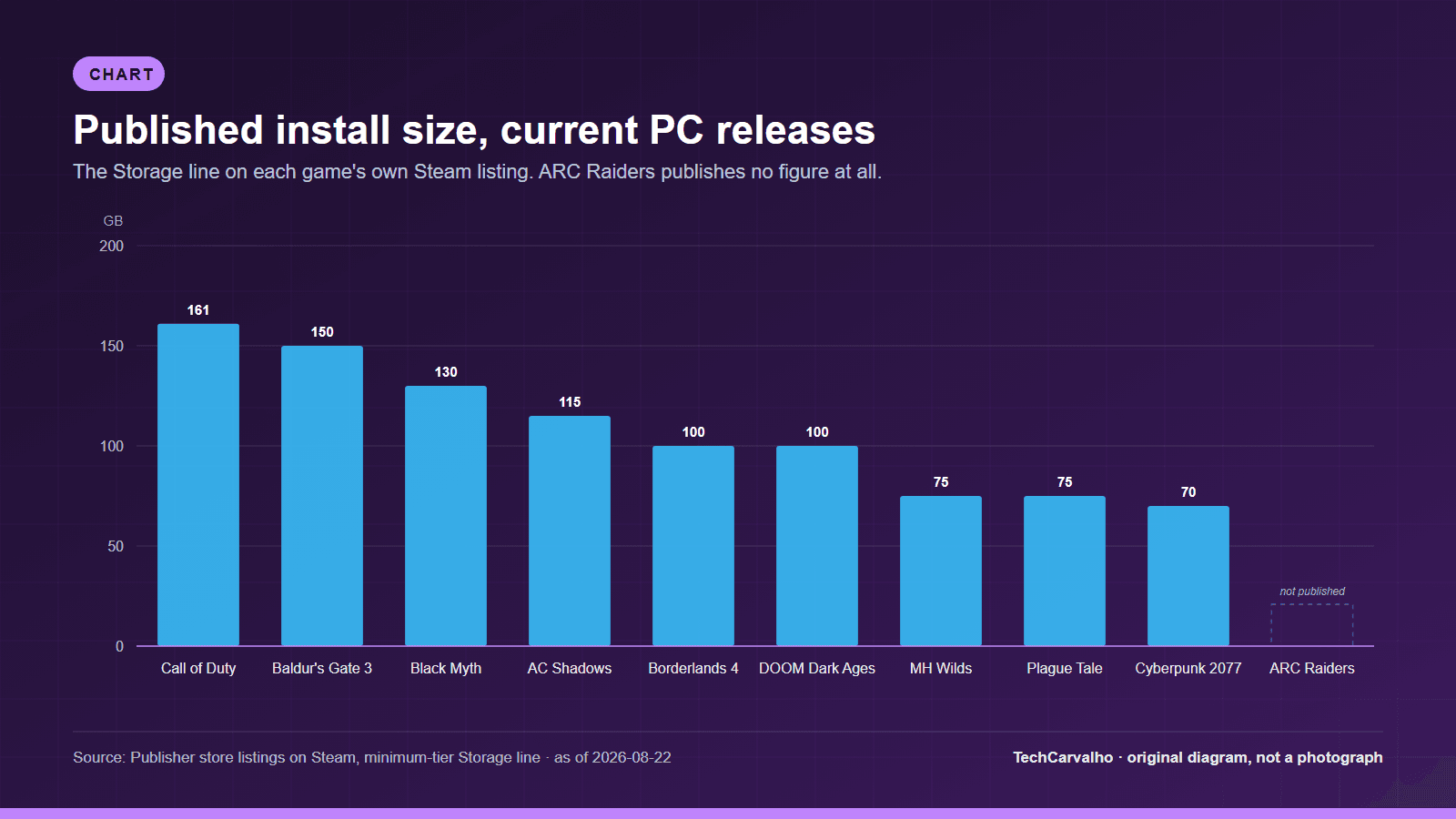
Published install sizes, current PC releases
These are the figures in the "Storage" line of each game's own Steam listing:
- Baldur's Gate 3 — 150 GB, with "SSD required" in both columns.
- Black Myth: Wukong — 130 GB. Minimum says "HDD Supported, SSD Recommended"; recommended says "SSD Required".
- Assassin's Creed Shadows — 115 GB, "The game must be installed on a SSD."
- Borderlands 4 — 100 GB, "SSD storage required".
- DOOM: The Dark Ages — 100 GB, "NVME SSD storage required".
- Monster Hunter Wilds — 75 GB.
- Resonance: A Plague Tale Legacy — 75 GB, "SSD Required".
- Cyberpunk 2077 — 70 GB.
- Elden Ring — 60 GB.
- The Blood of Dawnwalker — 60 GB, "Storage on SSD".
- Battlefield 6 — 55 GB minimum, 80 GB recommended.
- Onimusha: Way of the Sword — 50 GB.
- Microsoft Flight Simulator 2024 — 50 GB, alongside a stated network bandwidth requirement.
- Call of Duty (the shared Call of Duty HQ listing) — "SSD with 161 GB available space at launch".
Two things jump out. The first is that the biggest number on this list belongs to a 2023 role-playing game, not a 2026 shooter — install size tracks how much uncompressed audio, video and texture data a game ships, not how new it is. The second is that Call of Duty's figure is the only one carrying an explicit hedge: "at launch". Activision is telling you the number will move.
The SSD stopped being optional, and you can watch it happen
Black Myth: Wukong (August 2024) is the clean illustration. Its minimum tier still says "HDD Supported". Its recommended tier says "SSD Required". That is a game shipped during the transition.
Everything on the list from 2025 onward that mentions storage type at all requires an SSD, and DOOM: The Dark Ages goes further and specifies NVMe in both columns. If you are still running games from a mechanical hard drive, that is now the constraint, not a preference.
Some publishers don't publish a figure at all
ARC Raiders, released 30 October 2025, has no storage line in either its minimum or its recommended block on Steam. Neither does Resident Evil Requiem, and neither does Phantom Blade Zero. Call of Duty: Modern Warfare 4's entire requirements block currently reads "TBD".
There is no way to plan around a number that has not been published, and estimating one would just be guessing with extra steps. If a game you are waiting for has no storage figure, budget generously and check again nearer launch.
Console storage: what is advertised and what we can't tell you
From the platform holders' own product pages:
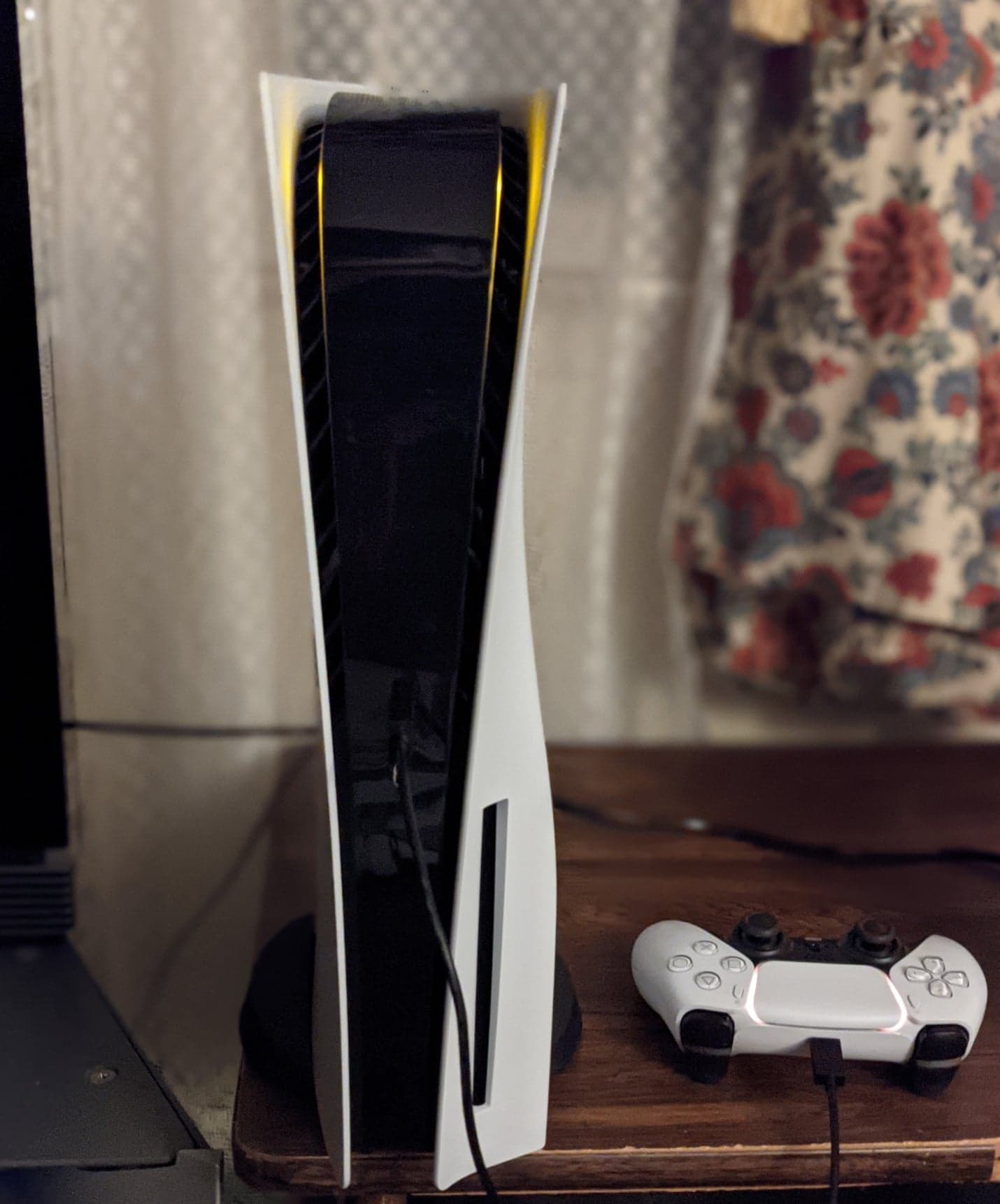
- PlayStation 5 — 1TB on the current standard model; the Digital Edition is listed at 825GB.
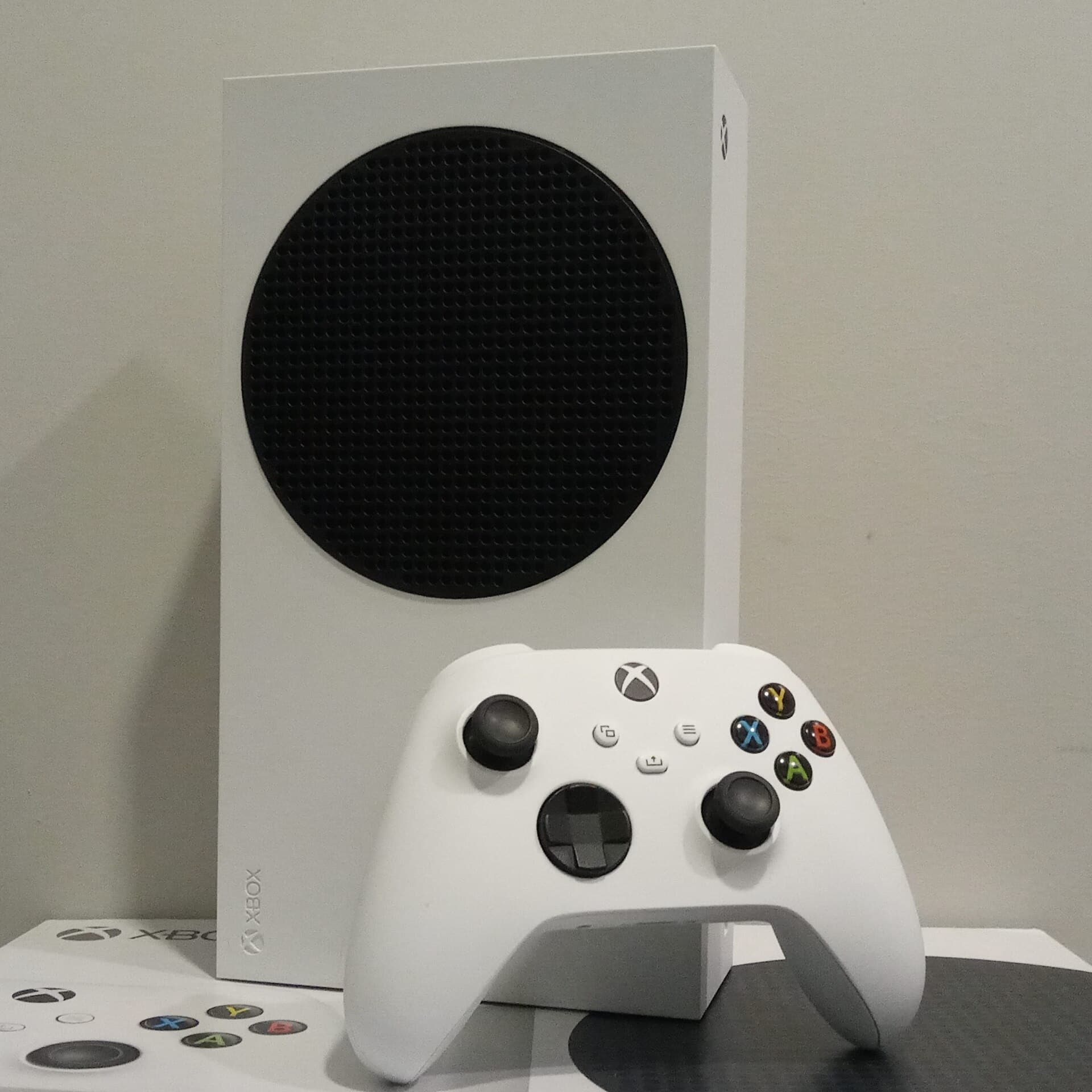
- Xbox Series X — "1TB Custom NVME SSD", with a "2TB Custom NVME SSD" Galaxy Black Special Edition.
Here is the honest part: neither Sony's nor Microsoft's product page states how much of that is actually free after system software and formatting overhead. Figures for usable capacity circulate widely, but we could not verify one from a first-party source while researching this piece, so we are not going to print one. What is certain is that the usable figure is meaningfully lower than the advertised figure, on every console, for the same reasons it is on every drive.
Put that next to the install sizes above and the arithmetic is uncomfortable: on a 1TB console, three or four current big-budget games plus their updates is a full drive.
Expanding PS5 storage has a specific and easily-mistaken set of requirements — interface, sequential read speed, and a heatsink height limit that catches people out. We have a separate guide covering exactly which drives qualify.
What the install-size number still doesn't include
The storage line covers the base install. It does not cover the day-one patch, later seasonal content, locally-cached shader compilation, screenshots and video captures, or a second copy that exists mid-update while a patch is being applied. None of those have published figures either. The practical effect is that a game listed at 100 GB should be planned for as noticeably more than 100 GB, and a drive that is 95 percent full will cause update failures long before it causes performance problems.
A sizing rule that holds up
- Count the games you genuinely keep installed at once, not the size of your library. For most people that number is between three and six.
- Multiply by roughly 100 GB for current big-budget titles. Older or smaller games pull the average down a lot.
- Add the operating system, and leave real headroom on top — a drive kept near capacity is a drive that fails updates.
- Buy capacity over peak sequential speed if you have to choose. Every game above requires an SSD; only DOOM specifies NVMe; none of them list a required read speed on PC.
When this doesn't matter
If you play two or three games and rotate slowly, a 1TB drive is genuinely fine and a bigger one is money spent on nothing. Deleting a finished 100 GB game takes thirty seconds.
If your library is mostly indie, older, or competitive multiplayer titles, the figures above are wildly unrepresentative — the games that dominate playtime charts are frequently a tenth of the size of the ones that dominate install-size charts.
If you are a console player who only ever has one live-service game installed, storage expansion is likely the least valuable upgrade available to you, and the money is better spent almost anywhere else.
And if you are choosing between a faster small drive and a slower large one for gaming specifically, note again that not one PC listing above states a required read speed. Capacity is the constraint that current games actually name.
Products covered
| Specification | Microsoft Xbox Series X | Microsoft Xbox Series S | Sony PlayStation 5 |
|---|---|---|---|
| CPU | AMD Zen 2, 8-core, 3.8GHz | AMD Zen 2, 8-core, 3.6GHz | AMD Zen 2, 8-core, up to 3.5GHz |
| GPU | AMD RDNA 2, 12 TFLOPS | AMD RDNA 2, 4 TFLOPS | AMD RDNA 2, 10.28 TFLOPS |
| RAM | 16GB GDDR6 | 10GB GDDR6 (8GB usable for games) | 16GB GDDR6 |
| Storage | 1TB NVMe SSD | 512GB NVMe SSD | 825GB NVMe SSD |
| Max output resolution | 4K/120fps (HDMI 2.1) | 1440p target, up to 120fps | 4K/120fps (HDMI 2.1) |
| Launch price (USD) | 799.99 USD | 499.99 USD | 649.99 USD |
Sources
- Microsoftprimary source
- Sony Interactive Entertainmentprimary source
- Embark Studios / Steam store listingprimary source
- Activision / Steam store listingprimary source
- EA / Battlefield Studios / Steam store listingprimary source
- id Software / Bethesda / Steam store listingprimary source
- Gearbox / 2K / Steam store listingprimary source
- Ubisoft / Steam store listingprimary source
- Game Science / Steam store listingprimary source
- Larian Studios / Steam store listingprimary source
Tech Carvalho does not publish hands-on test results. This piece is written from the sources above and from public documentation. See our editorial policy.