How Much Power Supply Do You Actually Need for an RTX 5090 Build?
The RTX 5090 has a Total Graphics Power (TGP) of 575W by itself. NVIDIA's own spec sheet, tested on a system built around a Ryzen 9 9950X, recommends a **1000W…
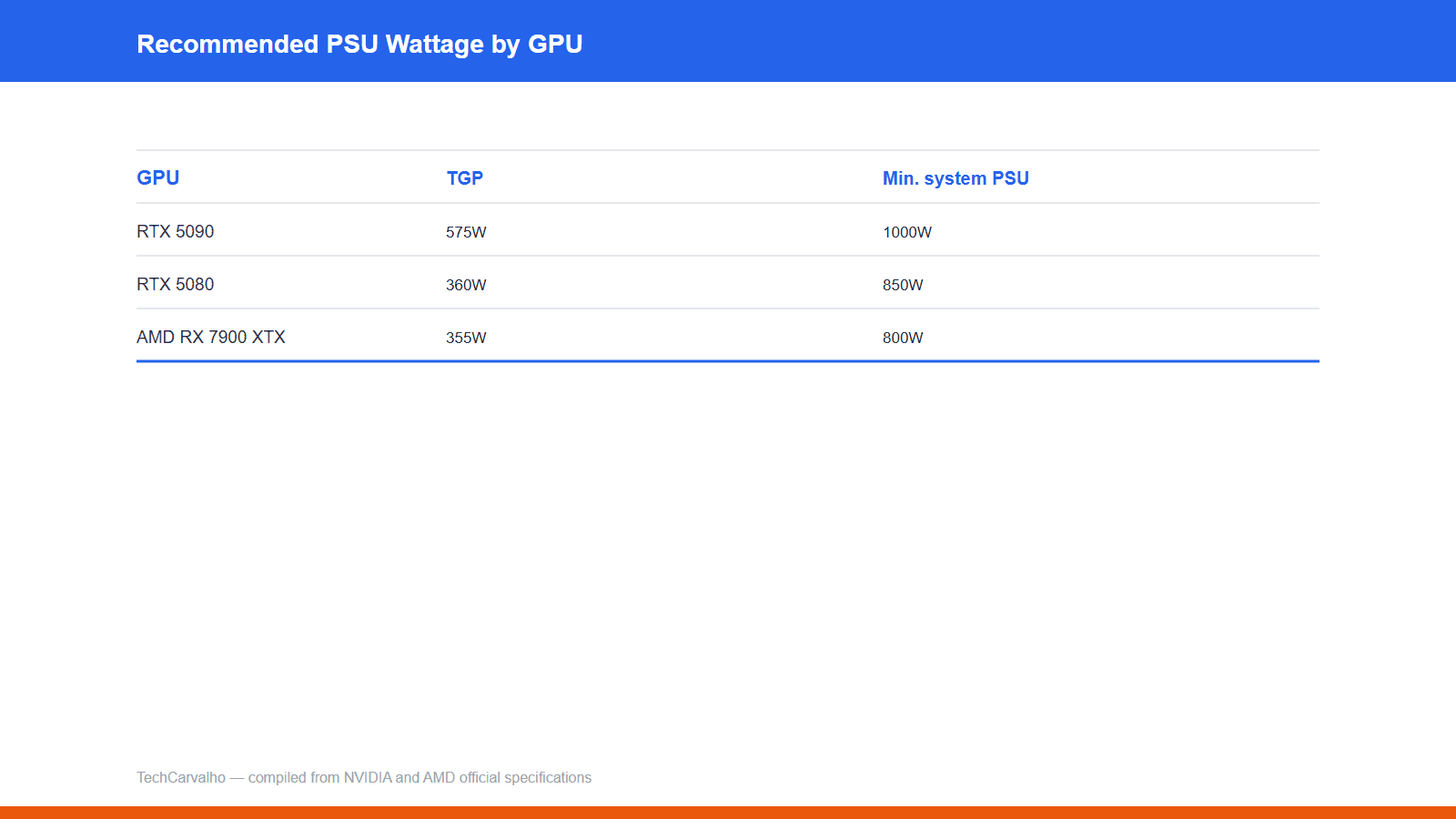
The RTX 5090 has a Total Graphics Power (TGP) of 575W by itself. NVIDIA's own spec sheet, tested on a system built around a Ryzen 9 9950X, recommends a **1000W minimum system power supply** — not 575W. That gap exists because the number covers the whole build, not just the card.
Why 1000W is the floor, not a comfortable number
If you're pairing the 5090 with the same class of CPU it was tested with, budget 150-250W for the processor alone under sustained load. If you're overclocking either component, or running multiple NVMe drives and a full fan array, go to 1200W. That headroom matters for a reason NVIDIA doesn't put on the spec sheet: independent lab testing on 5090-class cards has recorded millisecond-scale transient spikes well above rated TGP — some measurements approach 950W. A PSU sized exactly to TGP has no margin for those spikes.
Connector: don't cheap out here
The 5090 supports a single native PCIe Gen 5 (12V-2x6) cable rated 600W or greater — formerly known as 12VHPWR — or three to four PCIe 8-pin cables through the included adapter. The safest setup is a PSU with a **native ATX 3.0 or 3.1 12V-2x6 cable** rather than the bundled adapter. Adapters and daisy-chained cables are the most common cause of the connector-melting incidents that plagued early 12VHPWR adoption, because a poorly-seated pin on a chain of adapters concentrates current unevenly.
Compare that to the RTX 5080
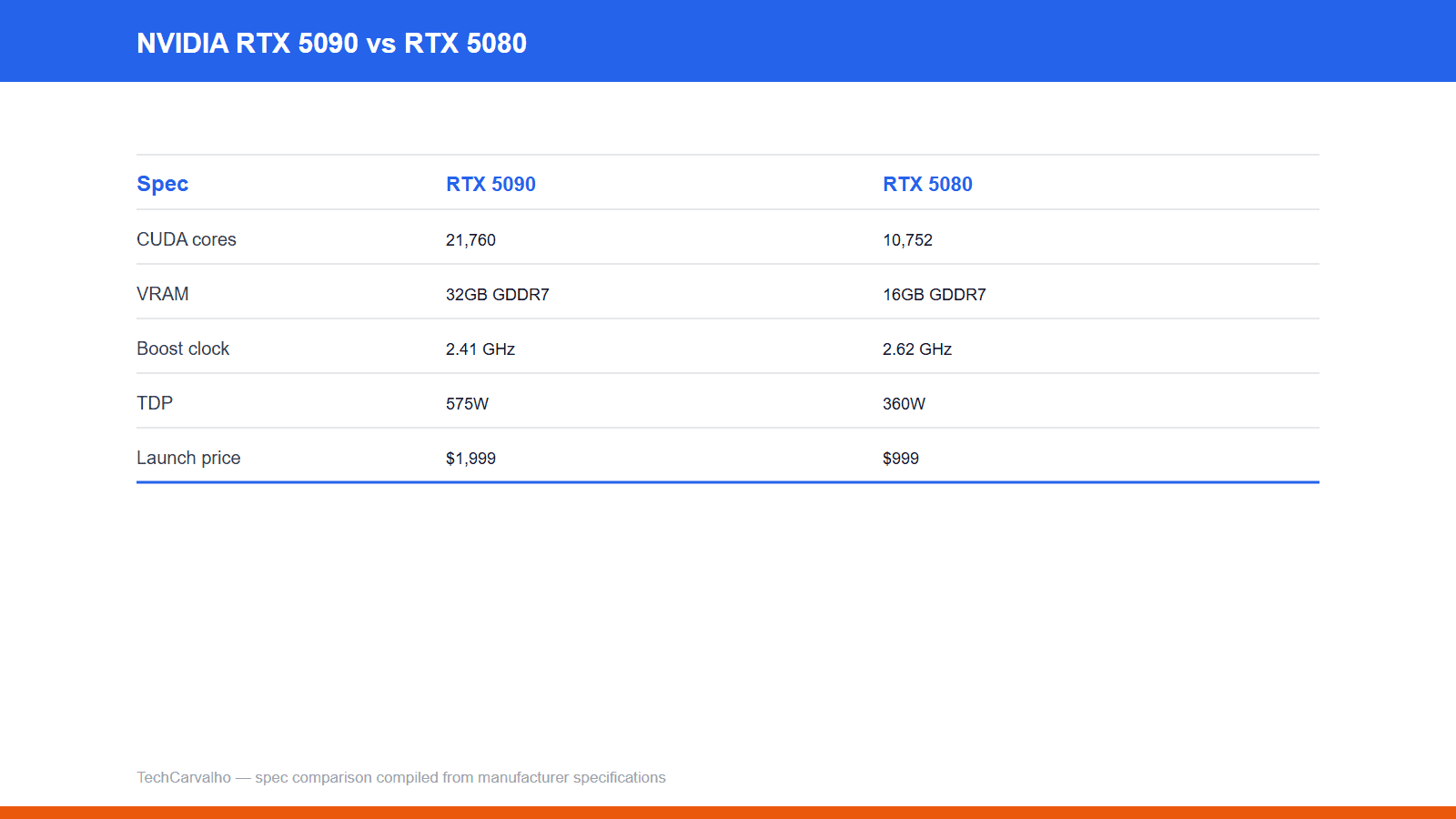
360W TGP, official 850W minimum system recommendation, using a 450W-rated 12V-2x6 cable or three 8-pin cables. If you're choosing between the two cards, the PSU cost difference is real and should factor into the decision alongside raw performance.
Efficiency rating
NVIDIA doesn't mandate an 80+ tier — that's a general quality signal, not a requirement. But at 1000W+ continuous draw, Gold-tier units are more likely to be built with components that handle transient spikes cleanly. Treat 80+ Gold as the practical floor for a 5090 build.
When NOT to spend more
If you're not running a 5090 or 5080, this level of PSU is overkill. The RX 7900 XTX only needs an 800W PSU with dual 8-pin connectors and no exotic connector standard. Don't buy a 1200W PSU "to be safe" for a mid-range build.
Products covered
| Specification | AMD Radeon RX 7900 XTX | NVIDIA GeForce RTX 5090 |
|---|---|---|
| Boost clock | up to 2.5 GHz | 2.41 GHz |
| TDP | 355W | 575W |
| VRAM | 24GB GDDR6 | 32GB GDDR7, 512-bit bus |
| CUDA/Stream cores | 6,144 stream processors | 21,760 CUDA cores |
| Launch price (USD) | 999 USD | 1999 USD |
Sources
Tech Carvalho does not publish hands-on test results. This piece is written from the sources above and from public documentation. See our editorial policy.