Do You Actually Need 4K or 8K Video Right Now?
What extra resolution actually buys you versus what it costs in storage and processing power, and why 4K is still the right answer for most people.
Resolution numbers are one of the easiest specs to market and one of the hardest to actually evaluate against your own needs, because "more resolution" sounds unambiguously better and rarely gets explained in terms of what it costs you to get there. It's worth separating the marketing claim from the practical question.
What resolution actually buys you
More resolution means more captured detail, which matters in two real scenarios: viewing the footage at a large size where individual detail is visible, and cropping or reframing in editing without visibly losing quality, since a 4K crop of an 8K source still leaves you with a full 4K image. Outside those two uses, additional resolution beyond what your output and viewing situation can actually display is capturing data you'll never see.
What it costs you
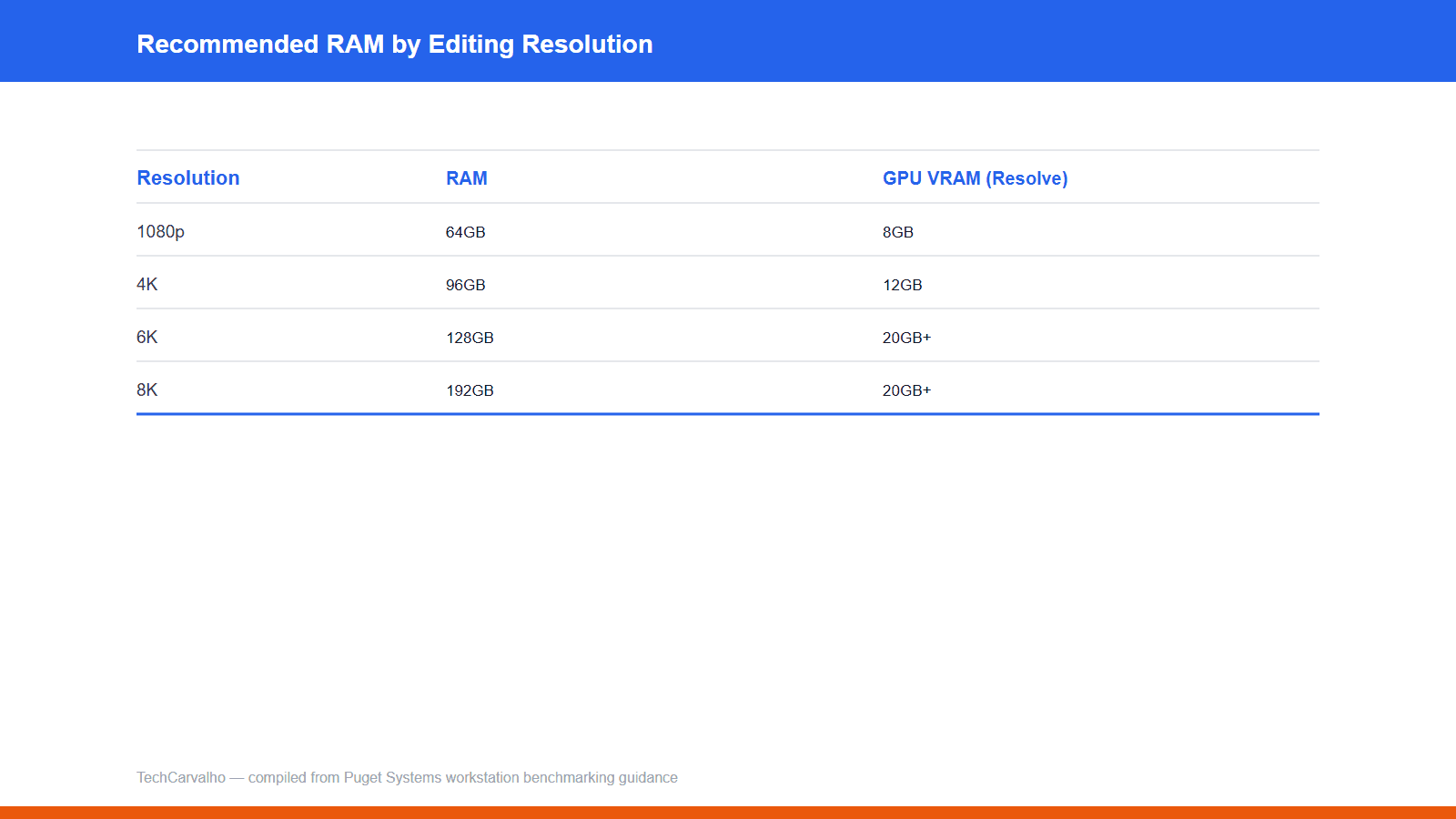
Storage, first and most directly — 8K footage is dramatically larger per minute than 4K, and 4K is dramatically larger than 1080p. That compounds across an editing workflow: more storage for originals, more storage for backups, more storage and processing power for any transcoded proxy files. Processing power, second — editing and color-grading high-resolution footage smoothly requires more capable hardware, and a system that handles 1080p or 4K editing comfortably may struggle with 8K. Battery life and thermal limits on the recording device itself, since higher-resolution encoding is more computationally demanding, which is part of why many cameras impose recording time limits specifically at their highest resolution modes.
Where 4K makes clear sense today
Most people. Most displays sold today are 4K-capable, most streaming platforms deliver up to 4K, and 4K gives real headroom to crop and stabilize footage in editing without a visible quality loss — genuinely useful for run-and-gun or handheld shooting where you'll want to reframe afterward. If you're unsure whether you need 4K, you almost certainly benefit from having it available, even if you don't always shoot in it.
Where 8K is a real answer, not a spec-sheet flex
Large-format cinema or exhibition display. Extremely aggressive cropping and reframing workflows, where you're deliberately treating an 8K frame as source material to punch into for multiple different final shots. Long-term archival where you want maximum future-proofing and have the storage budget to match. Outside those specific cases, 8K is frequently captured, viewed on something well below 8K, and never benefits from the extra resolution at all.
The honest framing
Resolution is a tool matched to a specific need — output size, cropping headroom, archival requirements — not a universal quality metric where higher is simply better. Buying or shooting more resolution than your workflow and output actually use is real cost (storage, processing power, battery life) for a benefit you'll never perceive. The right question isn't "what's the highest resolution available" — it's "what resolution does my actual output and editing process need," and for most people today, that answer is 4K, not 8K.