Memory Card Speed Classes Explained: V30, V60, V90, U3 and A2
An SD card can have five different speed markings on it, and they mean five different things. Most buying advice online conflates them. The SD Association…
An SD card can have five different speed markings on it, and they mean five different things. Most buying advice online conflates them. The SD Association defines them all, so there is no need to guess.
The one number that matters for video: the V-class
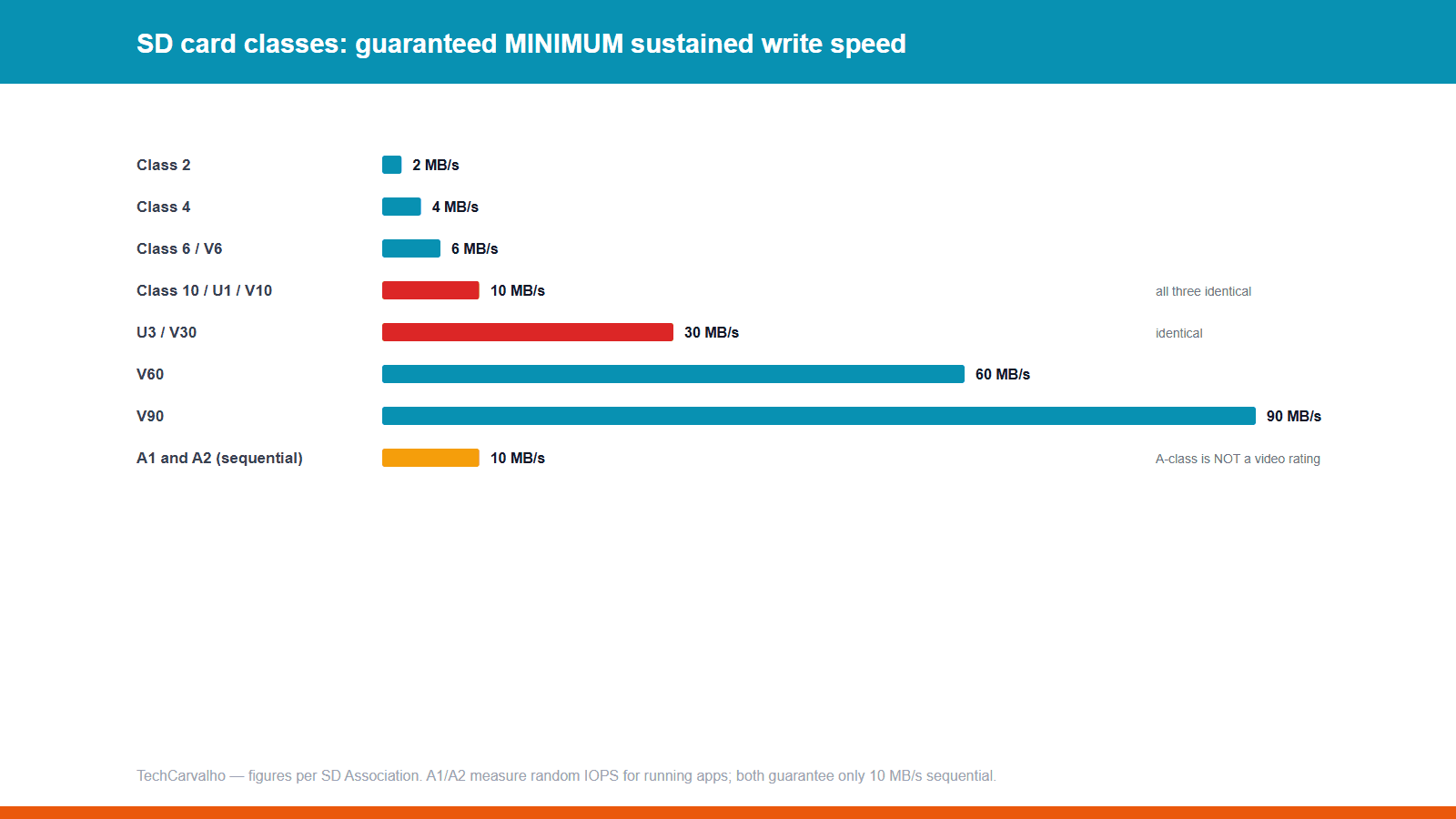
Video Speed Class is a **guaranteed minimum sequential write speed** in megabytes per second. The number in the symbol is the number: V6 is 6 MB/s, V10 is 10, V30 is 30, V60 is 60, V90 is 90.
The SD Association specifies that Speed Class write is defined to perform sequential writes to a completely un-fragmented area. That is the guarantee: sustained, sequential, worst case. It is not a peak figure, and that is exactly why it is the useful one. Video recording fails when the card's *floor* drops below the camera's bitrate, not when its ceiling is low.
To compare a V-class against a camera spec, convert. Camera bitrates are quoted in megabits per second; card classes in megabytes per second. Divide by 8. A 400 Mb/s codec needs 50 MB/s sustained, so a V60 card clears it and a V30 does not.
The older markings, and why they are mostly noise
The original Speed Class used the same convention: Class 2 = 2 MB/s, Class 4 = 4, Class 6 = 6, Class 10 = 10 MB/s minimum sequential write. UHS Speed Class has only two members: U1 = 10 MB/s and U3 = 30 MB/s.
Look at those side by side and the redundancy is obvious. Class 10, U1 and V10 all guarantee exactly 10 MB/s. U3 and V30 both guarantee exactly 30 MB/s. **If a card's highest marking is Class 10 or U1, it is a slow card, regardless of how the packaging is worded.**
The classes also map to bus generations. Per the SD Association, V6 and V10 apply to the High Speed and UHS bus families; V30 applies to UHS; V60 and V90 apply only to UHS-II and UHS-III products. This is why V60 and V90 cards have a second row of contacts — and why a V90 card in a UHS-I camera will not deliver V90 performance. The card cannot outrun the slot.
There is now also SD Express Speed Class, using the same convention at much higher figures: E150 through E600.
A1 and A2 have nothing to do with video
This is the most common misunderstanding, and it costs people money.
Application Performance Class measures **random** access, not sustained sequential throughput. The SD Association defines IOPS here as the number of 4 KB read/write commands executable per second. A1 requires 1,500 minimum random read IOPS and 500 random write IOPS. A2 requires 4,000 and 2,000 respectively, achieving this using Command Queuing and Cache. The stated purpose is running applications and application data from the card.
Note the sequential figure in both: **A1 and A2 each guarantee only 10 MB/s sustained sequential write.** An A2 card is not a fast video card. It is optimised for a Raspberry Pi, a handheld console, or a phone running apps off the card. If you are buying for a camera, A2 on the label tells you nothing you need.
When none of this matters
If you shoot stills — even bursts of large raw files — speed class is largely irrelevant to whether the shot succeeds. Your buffer, not the card, sets burst depth. Class ratings govern *sustained* write, which is a video problem.
Two things to buy on instead: match or exceed your camera's stated minimum card requirement, and buy from a retailer you trust, because counterfeit cards misreport their capabilities and no printed symbol protects you from a fake.
Sources
- SD Associationprimary source
- SD Associationprimary source
Tech Carvalho does not publish hands-on test results. This piece is written from the sources above and from public documentation. See our editorial policy.