The Bortle Scale: What Your Sky Class Actually Means for Astrophotography
If you have started reading astrophotography forums, you have seen people describe their location as "Bortle 4" or "Bortle 8" as though it were a hardware…
If you have started reading astrophotography forums, you have seen people describe their location as "Bortle 4" or "Bortle 8" as though it were a hardware spec. It is not, and it is worth understanding what it actually is before you let it discourage you.
What the scale actually measures
The Bortle Dark-Sky Scale is a nine-point classification of night sky darkness created by amateur astronomer John E. Bortle and published in Sky & Telescope in February 2001. Crucially, it is a **visual** scale. Bortle defined each class by what a person with dark-adapted eyes can see: whether the Milky Way is visible, whether it casts a shadow, whether specific deep-sky objects are naked-eye targets.
That distinction matters, because it is the root of most confusion. Bortle class describes what your eyes can do. A camera on a tracking mount stacking sixty exposures is doing something your eyes cannot do at all.
The classes, briefly
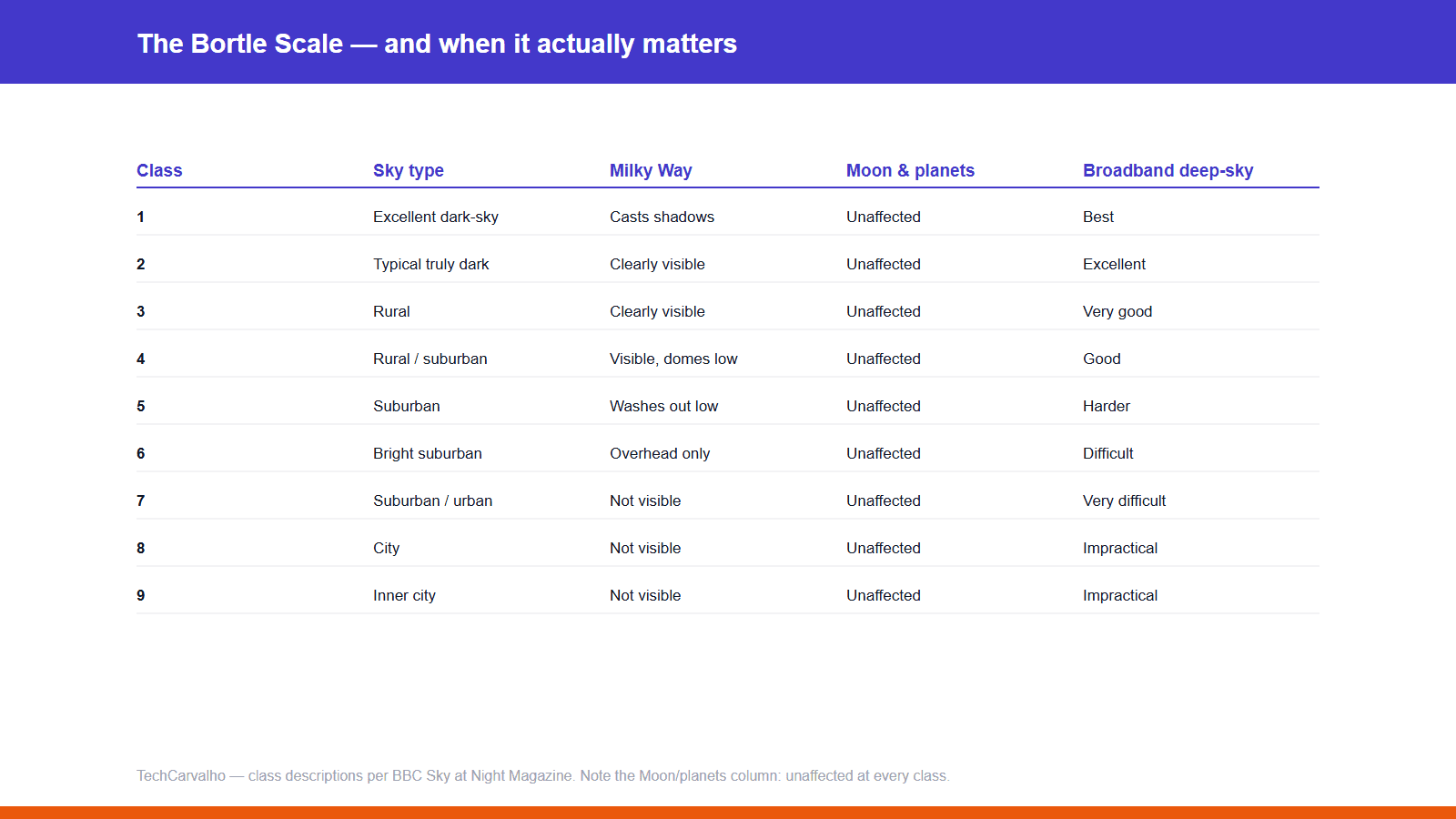
Class 1 is an excellent dark-sky site, where the Milky Way is bright enough to cast shadows. Class 2 is a typical truly dark site. Class 3 is rural, where light pollution appears as domes on the horizon but overhead detail survives. Class 4 is the rural/suburban transition. Class 5 is suburban, where the Milky Way washes out near the horizon. Class 6 is bright suburban, with the Milky Way surviving only overhead. Class 7 is the suburban/urban transition, the sky a murky white. Class 8 is a city sky. Class 9 is inner-city, where the only real targets are the Moon, bright planets and satellites.
Naked-eye limiting magnitude is often quoted alongside each class, but treat those numbers as indicative rather than definitive — they depend heavily on the observer's eyes.
The part most articles skip
**For a large fraction of what you probably want to photograph, your Bortle class does not matter much.**
The Moon does not care. It is the brightest object in the night sky and is completely unaffected by skyglow. Lunar photography from a Bortle 9 balcony is genuinely as good as lunar photography from a desert. The same is broadly true of the bright planets. If your ambition is Jupiter's belts or a sharp crater terminator, stop worrying about light pollution entirely — your limiting factors are atmospheric seeing, focus and focal length.
Where it genuinely bites
Bortle class matters when you photograph faint, extended objects: nebulae, galaxies, the Milky Way core. Skyglow adds a bright, noisy background to every sub-exposure. It does not simply add brightness you can subtract away; it adds photon shot noise you can only fight with more total integration time. That is the honest trade — worse skies mean more hours for the same result, not necessarily an impossible result.
One structural exception is worth knowing. Emission nebulae radiate in narrow spectral lines, and narrowband filters pass those lines while rejecting most broadband skyglow. This is why people successfully shoot the Orion Nebula from suburbs. Broadband targets — galaxies, reflection nebulae, star colour — get no such rescue, and those are the ones that genuinely reward travelling.
How unusual dark sky now is
Falchi and colleagues, writing in Science Advances in 2016, found that about 83% of the world's population and more than 99% of the US and European populations live under light-polluted skies, and that the Milky Way is not visible to more than a third of humanity. The US National Park Service reports citizen-science data showing average night sky brightness increasing 9.6% per year between 2011 and 2022 — a doubling roughly every eight years.
So check your class, then check your target list. For half of them the number is irrelevant.
Sources
- Falchi et al., Science Advances 2016primary source
- US National Park Serviceprimary source
- BBC Sky at Night Magazine
Tech Carvalho does not publish hands-on test results. This piece is written from the sources above and from public documentation. See our editorial policy.