Planning an Astrophotography Night: Moon Phase, Twilight and Timing
A clear forecast is not the same as a good night. Two things decide whether the hours you spend outside produce anything: where the Moon is, and when real…
A clear forecast is not the same as a good night. Two things decide whether the hours you spend outside produce anything: where the Moon is, and when real darkness actually starts. Both are precisely predictable, which makes this the easiest part of astrophotography to get right.
Twilight is defined by the Sun's angle, not by how dark it looks
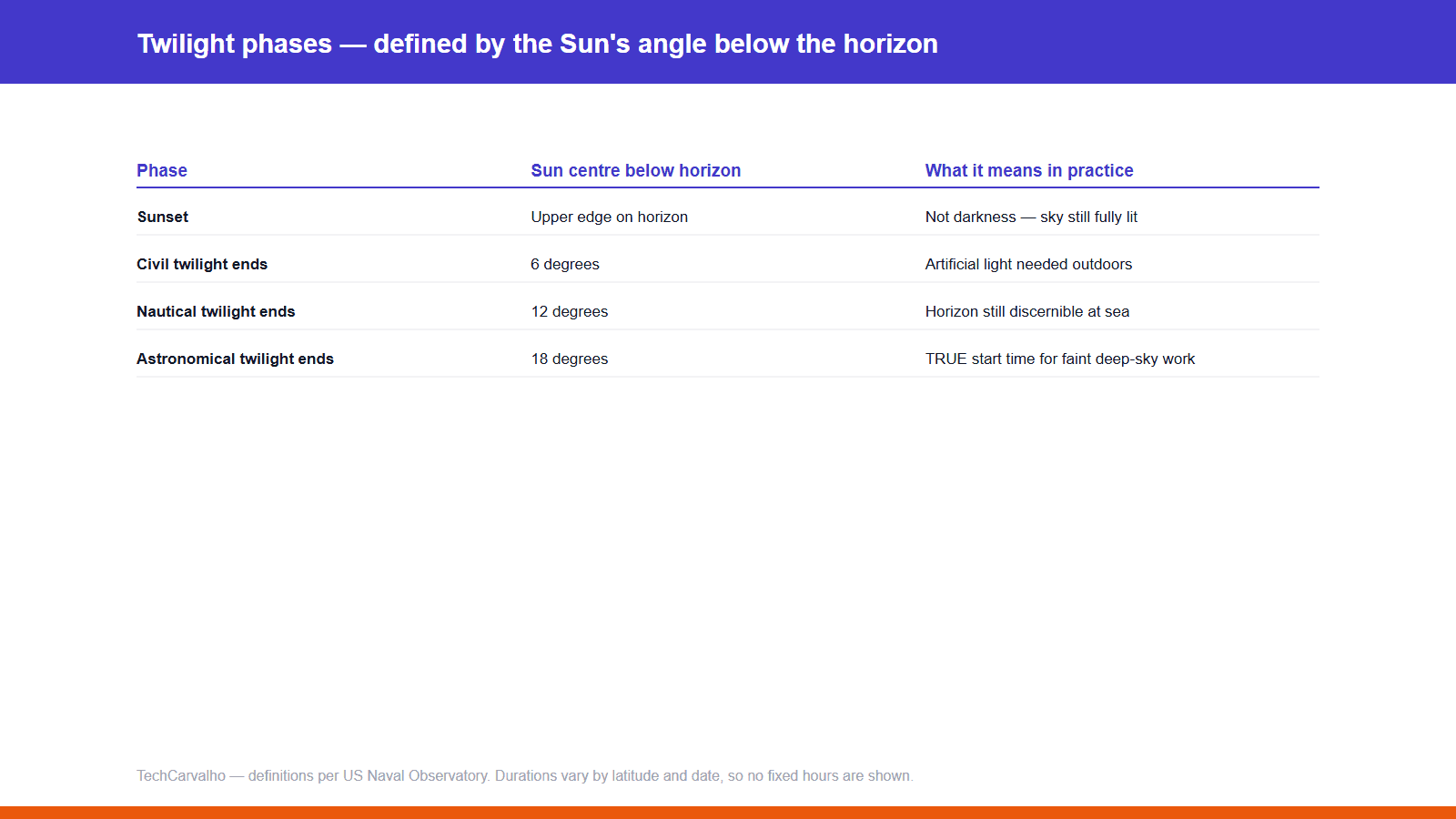
The US Naval Observatory defines the three twilight phases by the geometric altitude of the centre of the Sun below the horizon:
- **Civil twilight** ends when the Sun's centre is 6 degrees below the horizon. After this, artificial lighting is generally needed outdoors.
- **Nautical twilight** ends at 12 degrees below the horizon — the level at which mariners can still make out the horizon for star sights.
- **Astronomical twilight** ends at 18 degrees below the horizon. Beyond that, scattered sunlight is negligible compared with starlight.
Sunset itself is defined as the moment the upper edge of the Sun's disk is on the horizon.
The practical consequence: **astronomical twilight is your real start time for faint deep-sky work**, not sunset. Depending on latitude and season, the gap can be well over an hour and a half. If you start stacking sub-exposures at the end of civil twilight, your early frames carry a sky gradient you will spend longer fighting in processing than you saved by starting early.
The corollary is less often said: at high latitudes in midsummer, the Sun never reaches 18 degrees below the horizon at all. Astronomical twilight never ends. If that is your situation, no amount of patience produces a dark sky, and the correct response is to shoot the Moon or planets instead of fighting an unwinnable battle.
Moon phase is the other half
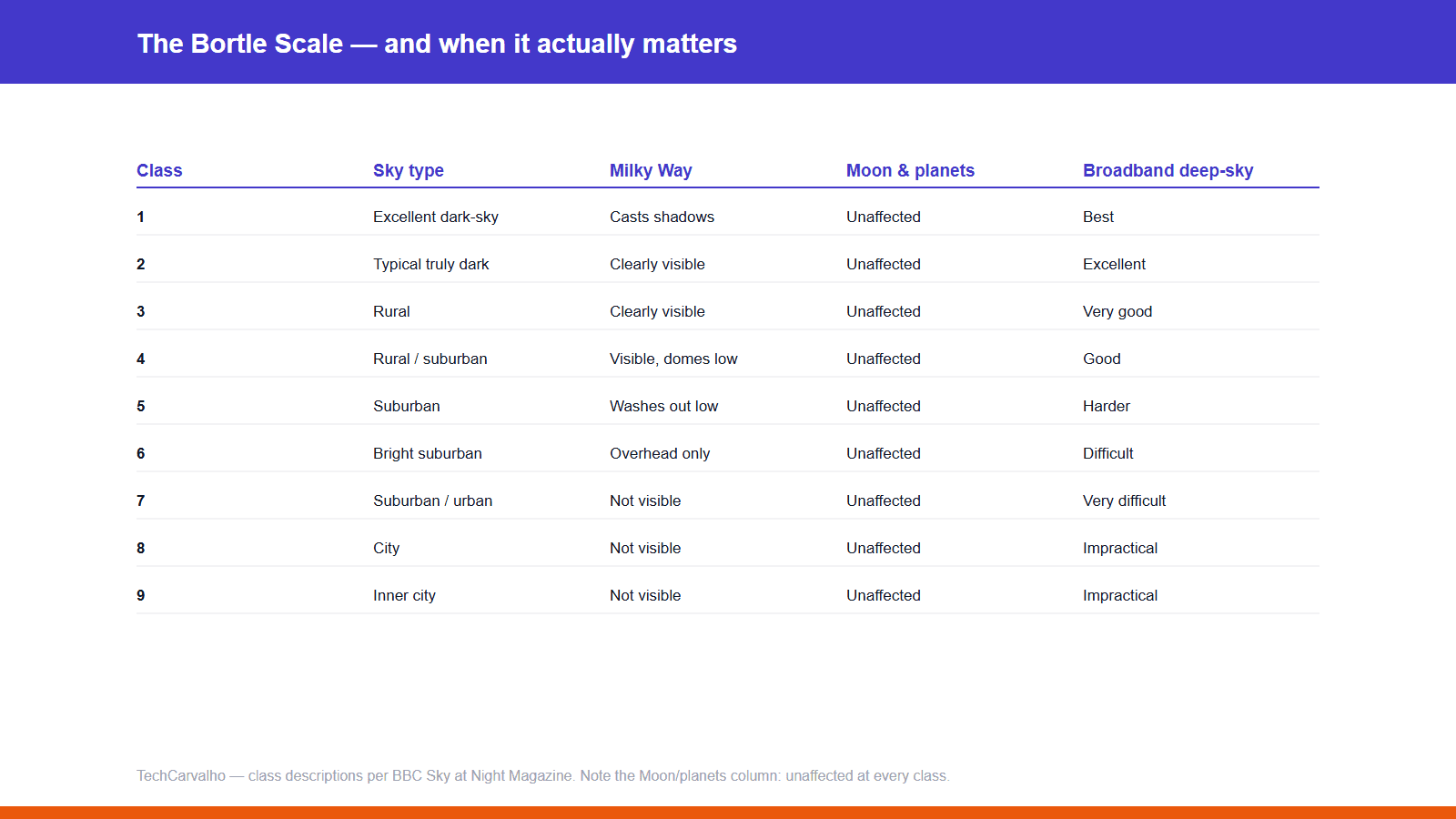
The Moon runs through its full cycle of phases in an average of about 29.5 days. For faint deep-sky targets the Moon is the enemy, because a bright Moon raises the background brightness of every frame — the same problem as light pollution, only mobile and predictable. The week around new moon is the window everyone competes for.
But phase alone is not the whole answer, and this is where beginners lose nights unnecessarily. **What matters is whether the Moon is above the horizon while you are shooting, not what phase it is.** The USNO notes that a full Moon rises around sunset and sets around sunrise for most places on Earth — which is exactly why a full moon ruins an entire night. A waning crescent may not rise until the small hours, leaving several genuinely dark hours after astronomical twilight ends. A waxing crescent sets early in the evening. Learn to read moonrise and moonset times and you will recover perhaps a third of the nights you would otherwise write off.
When none of this matters
If your target is the Moon, invert everything above. You want the Moon high, you do not need astronomical twilight, and you do not need a dark site. A first- or last-quarter Moon is usually a better subject than a full one, because shadows near the terminator give craters visible relief, whereas a full Moon is lit head-on and looks flat.
Planetary imaging is similarly indifferent to both moonlight and twilight. What limits planetary detail is atmospheric seeing and the object's altitude — a planet low on the horizon is viewed through far more atmosphere than one near the zenith.
So the planning question is not "is tonight a good night?" It is "what is tonight a good night *for*?" A bright Moon and a clear sky is a wasted night for galaxies and an excellent night for lunar work. Match the target to the conditions and you will shoot far more often than the people waiting for perfect new-moon weekends.
Sources
- US Naval Observatoryprimary source
- US Naval Observatoryprimary source
Tech Carvalho does not publish hands-on test results. This piece is written from the sources above and from public documentation. See our editorial policy.