Solar Photography Safety: What You Must Know Before You Point a Camera at the Sun
Why sunglasses and stacked ND filters aren't safe substitutes for a real solar filter, where the filter actually goes, and the one moment during an eclipse when removing it is safe.
Every other guide in this series treats camera settings as the main event. This one doesn't, because getting the settings wrong here produces a bad photo, and getting the safety wrong can cause permanent eye damage or destroy a camera. Read this before you point any camera, with or without a telephoto lens attached, anywhere near the sun.
The core danger, stated plainly
Looking directly at the sun — with your naked eye, through an unfiltered optical viewfinder, or through an unfiltered lens — can injure the retina, a form of damage called solar retinopathy that can cause lasting changes to vision. That's not a general "be careful" caveat tacked onto a technique guide; it's the entire reason every recommendation below exists.
What actually protects you: a purpose-built solar filter, not a substitute
A proper solar filter for a camera lens is designed to block sunlight to a safe level across the wavelengths that matter — visible, ultraviolet, and infrared — and mounts securely over the front of the lens, so no unfiltered sunlight can enter the optical path at all. According to the American Astronomical Society's eclipse eye-safety guidance, the ISO 12312-2 standard is written specifically for unaided-eye products like eclipse glasses and handheld solar viewers, and doesn't itself certify telescope or camera filters — but material that meets that standard's transmittance, uniformity, and quality requirements is considered suitable for that use too. Treat ISO 12312-2 as a reasonable baseline to look for in the filter material, but confirm what you're buying is specifically sold as a camera or telescope optical filter, not a handheld eclipse viewer being repurposed as one.
What is never a safe substitute
Sunglasses, exposed or undeveloped photographic film, smoked glass, or stacked neutral-density filters not rated for solar use. None of these reliably block the specific combination of visible, UV, and infrared wavelengths that cause actual damage, no matter how dark they look to the eye.
Where the filter goes, and why that matters
A solar filter belongs on the front of the lens, before any light enters the optical system — never as a rear or eyepiece-side filter, and never used as something you hold up and look through with the naked eye. A handheld eclipse viewer and an optical filter built for mounting on a lens or telescope are not interchangeable; the AAS is explicit that optical solar filters must never be used as handheld viewers, and eclipse glasses must never be used with optical instruments like telephoto lenses or telescopes.
Composing your shot doesn't make it safe
Using an electronic viewfinder or a mirrorless camera's rear screen to compose doesn't remove the risk. Concentrated, unfiltered sunlight passing through a telephoto lens can generate enough heat to damage a camera's shutter, internal components, or sensor, independent of whether anyone is looking through an optical viewfinder at the time — the equipment risk and the eye risk are separate problems, and a proper front-mounted filter protects against both.
The one exception: totality during a total solar eclipse
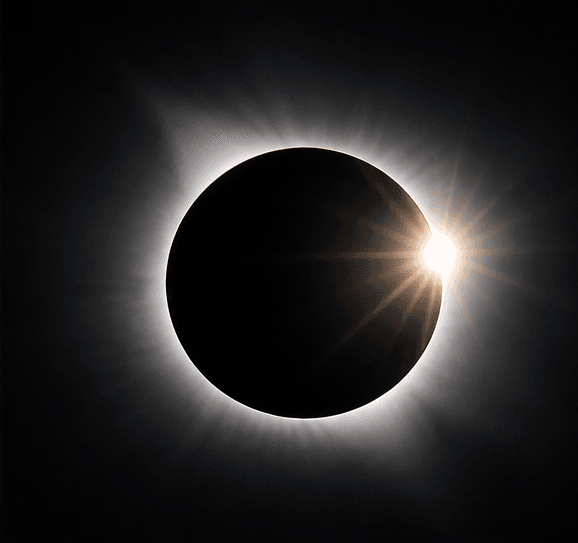
During the brief period of totality in a total solar eclipse — when the Moon fully covers the sun's disk — it becomes safe to remove filters, for both eyes and camera, for that specific window only. Every other phase of an eclipse, including the partial phases immediately before and after totality, needs the same filtering as any other day you'd point a camera at the sun. Timing matters enormously here: removing a filter even seconds before totality actually begins, or leaving it off seconds after totality ends, risks the same damage as never using a filter at all. If you aren't located within the path of totality, none of this exception applies to you — treat the entire event as requiring a filter throughout.
A practical checklist before you shoot
Confirm your filter is sold specifically for camera or telescope use, not a handheld-only eclipse viewer. Mount it securely on the front of the lens before pointing the camera anywhere near the sun. Never look through an unfiltered optical viewfinder at the sun, even briefly, even just to check framing. If you're shooting a total eclipse, know your local totality start and end times precisely, and treat the filter-off window as strictly limited to that period.
The honest bottom line
Get the filter and the timing right first. The actual astrophotography technique — exposure, framing, focus — only matters once that's settled, and none of it is worth attempting with equipment or a method you're not certain is actually safe.
Sources
- American Astronomical Societyprimary source
- DPReview
Tech Carvalho does not publish hands-on test results. This piece is written from the sources above and from public documentation. See our editorial policy.