Mesh Wi-Fi vs a Single Router: Do You Actually Need Mesh
The one structural problem mesh actually solves, why wired backhaul matters more than any other mesh spec, and when a single router is still the right buy.
Mesh systems are marketed as the default fix for weak Wi-Fi, but per our troubleshooting guide, most weak-Wi-Fi problems aren't actually a "need more access points" problem. Mesh solves one specific limitation a single router has — it's worth being clear about exactly which limitation that is before spending the extra money on it.
What a single router actually is, structurally
One radio, or set of radios on a dual/tri-band unit, broadcasting from one physical location. Its coverage is a function of transmit power and the physical obstructions between it and your device — walls, floors, distance. No matter how capable the router, it can't put a strong signal somewhere its radio waves physically can't efficiently reach.
What mesh actually adds
Multiple access points — a main unit plus one or more satellite nodes, placed around your home — all presenting as a single Wi-Fi network with one name, that your devices roam between automatically as you move. That's a real structural difference from an old-style range extender, which typically creates a second, separate network name you have to switch to manually. Mesh is a genuine fix for a genuine structural problem: a home large enough, or with enough obstruction, that a single router's radios physically can't reach every room with a usable signal.
Wired backhaul vs wireless backhaul — the detail that actually determines mesh performance
The connection between mesh nodes, called the backhaul, can be wired (an Ethernet cable run between nodes) or wireless (the nodes talk to each other over Wi-Fi, sometimes on a dedicated radio band reserved for that purpose on tri-band systems). Wired backhaul performs meaningfully better and more consistently, since it isn't sharing airtime with your devices' own traffic. Wireless backhaul is more convenient to install but adds a real performance ceiling, especially on cheaper dual-band systems where node-to-node traffic competes directly with client traffic on the same band — this is a genuine spec worth checking before buying, not a minor detail.
When mesh is actually the right answer
Your home is large enough, or has enough dense-material walls and floors (concrete, brick, in-floor heating), that a single well-placed router genuinely can't cover it — the core structural case for mesh, and the same coverage problem described in our troubleshooting guide. Multiple floors, where a router on one level consistently struggles to reach the far end of another. You want seamless roaming for devices that move around a large space during use — video calls while walking through the house, whole-home audio — without a manual network switch.
When mesh is very likely solving the wrong problem
Slow speeds despite full signal strength in every room — that's usually an ISP plan, a backhaul, or a device-band problem, not a coverage problem, and mesh won't fix it. A small or single-floor home where you haven't yet tried repositioning your existing router — check the placement and interference steps in our troubleshooting guide first, since a badly placed single router is frequently mistaken for a "need mesh" problem. Wanting a specific technical feature — a newer Wi-Fi standard, more Ethernet ports, better parental controls — that's really a router-generation question, not a coverage question; a single new router might be the actually-correct purchase there, not a mesh system.
The honest cost trade-off
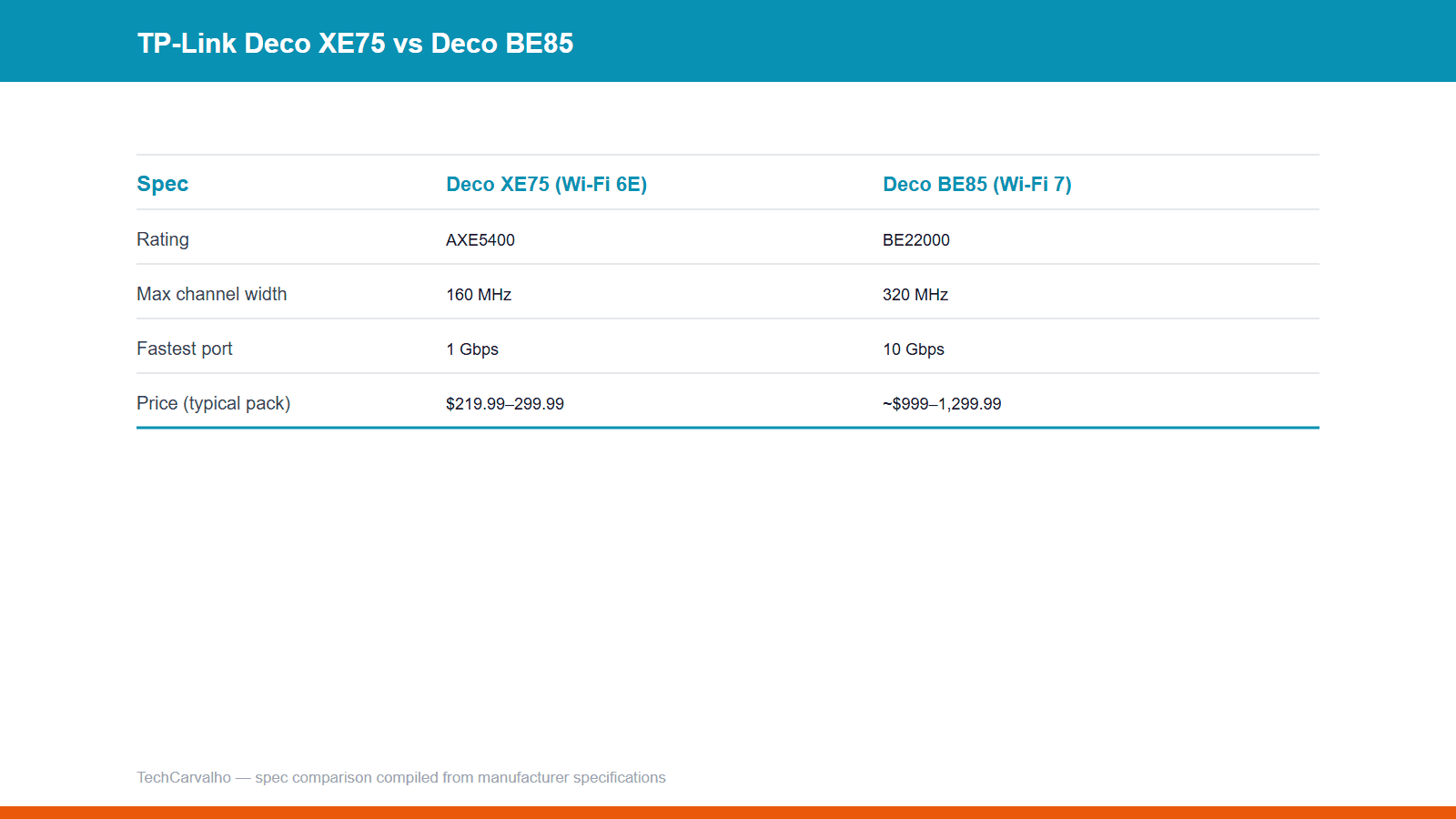
Mesh systems generally cost more than an equivalent single high-end router, and that cost scales further with each additional node. If your actual problem is a router old enough to lack modern Wi-Fi standards, that money might be better spent on one genuinely capable single router than spread across several mesh nodes solving a coverage problem you don't actually have.
The bottom line
Mesh solves coverage across physical space; it doesn't inherently solve raw speed, and it isn't automatically the better choice over a single router. It's the correct choice specifically when your home's size or layout is the actual limiting factor — worth confirming with the free checks in our troubleshooting guide before spending the extra money.
Related comparisons
Other head-to-heads covering the same subject.